| History of Dakota - US Relationships |
The following is a partial list of events that took place up to the time that the Dakota were forced to leave thier homeland - Southern Minnesota. It explains the cause of Historical Trauma that now affects many of the Dakota people today and why forgiveness and reconciliation is so important.
History of Dakota-US Relationships
in Minnesota
- Treaties and Cession of Land
- July 23, 1851: The Treaty of Traverse de Sioux
- Aug 5, 1851: The Treaty of Mendota
- Through both treaties, the Dakota gave up almost 24 million acres of land in what is now Southern Minnesota and parts of Iowa and South Dakota
- In Exchange:
- The Dakota was promised (but never received) $3,075,000
- $1,665,000 from the Treaty of Traverse de Sioux
- $1,410,000 from the Treaty of Mendota
- the U.S. was to make annual payments in food and gold
- The Dakota were also forced to sign another document that gave $400,000 to traders for debts they owed
- In addition:
- The Dakota would retain two reservations, each 20 miles wide and 70 miles long, along both sides of the Minnesota River
- The U.S. would provide assistance with schools, trade, and farming
- According to some sources, U.S. officials coerced Dakota leaders to sign the treaty by threatening to withhold rations or take the land by force
- The U.S. Senate refused to uphold its own responsibility in the treaty by eliminating the passage that granted the Dakota a reservation
Members of Congress from the Southern States did not want another Northern State that would oppose slavery. They believed that the Dakota would reject the treaty if they removed the passage that granted them a reservation. Assurances were given that the reservation would be established anyway so the Dakota reluctantly agreed.
- After the treaty was signed, immigration greatly increased and settlers began to encroach on the Dakota reservation
- Borders were redrawn to accomadate the settlers which reduced the size of the reservation
- Food subsidies arrived late and were often rotten
- More Land Taken
- March 13, 1858: 26 Dakota Chiefs were taken to Washington to meet with President James Buchanan
- After being held in Washington for four months they were told they had to give up their land North of the Minnesota River
- According to Indian accounts, most of that money went to the traders as well
- Hunger and Frustration Sets In
- A blight severely damaged Dakota crops in the spring and early summer of 1862.
- Food shortages coupled by late annuity payments from the government caused widespread hunger since most traders ended Dakota credit.
- Frustration and hunger led to foraging.
- August 17, 1862: One Indian foraging party attacked a family of settlers near Acton, MN
- The Dakota gathered. Tribal members managed to convince the Dakota leader Little Crow that the time to go to war against the settlers was at hand.
- War
- The 1862 U.S.-Dakota War was a result of repeated breaches of treaty agreement by the U.S. government, specifically the violation of the Treaty of Traverse des Sioux.
- August 18, 1862: A Dakota force struck the Lower Sioux Agency
- August 19, 1862: First Attack on New Ulm
- August 20, 1862: First Attack on Fort Ridgely
- August 22, 1862: Main Attack on Fort Ridgely
- August 23, 1862: Second Attack on New Ulm
- September 2, 1862: Battle of Birch Coulee
- September 3, 1862: Attack on Fort Abercrombie
- September 4, 1862: Attacks on Forest City and Hutchison
- September 6, 1862: Second Attack on Fort Abercrombie
- September 23, 1862: Battle of Wood Lake
- September 26, 1862: Surrender of Captives at Camp Release
- September 28, 1862: Military Commission Appointed to Try Indians who Participated in the Uprising
- December 26, 1862: Thirty-eight Sioux Executed at Mankato
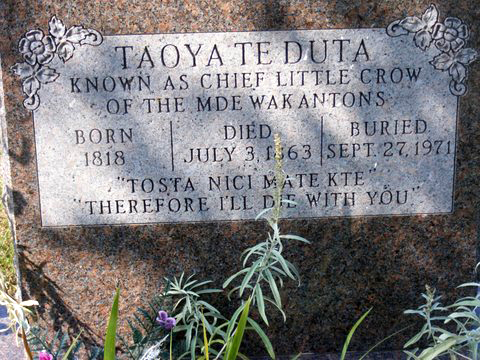
- July 3rd, 1863: Little Crow was shot by farmer Nathan Lamson while picking raspberries near Hutchinson, MN.
- Both sides suffered greatly, but the suffering of the Dakota people did not end with the war.
- Aftermath
- Many Dakota people fled after the war to escape being killed or captured.
- Many died from exposure or starvation during their flight
- 1700 women, children, and elders were rounded up
- They were forced to march from the Lower Sioux Agency to a concentration camp at Fort Snelling.
- They walked 20 miles a day.
- Along the way they were subjected to physical and verbal violence by local white people.
- New Ulm residents poured hot, scalding water over their heads.
- Many were killed or died from hunger and sickness.
- The men were taken to a prison camp in Mankato, MN.
- Along the way they were assaulted by mobs.
- Some died after being beaten with whips and pitchforks.
- War Trials
- Military trials of 425 Dakota warriors took on a farcical air
- Many trials lasted only a few minutes
- Many convictions relied upon testimony of defendants that plea-bargained in return for leniency
- 321 men were convicted and all but 18 sentenced to die
- Bishop Whipple, an Episcopalian, convinced President Abraham Lincoln to intervene
- Lincoln commuted most of the sentences to prison, but he upheld the convictions of 38 to appease angry white settlers
- On December 26, 1862, three thousand people gathered to watch the hanging of these thirty-eight Dakota in Mankato, MN
- It was the largest mass execution in U.S. history
- The remaining Dakota prisoners were treated with brutality
- Soldiers held prisoners at Fort Snelling through the winter
- At Ft. Snelling:
- State Founders hatched schemes to swindle the Dakota and consign them to reservations where hunger and corruption ruled
- 2,000 Dakota prisoners, mostly women and children, were kept in a camp forced to endure squalid conditions
- The soldiers treated them brutally, violating the women and then killing them
- Many people died from disease because of the crowded conditions
- Others committed suicide because of the horrors they saw there
- Some days soldiers buried as many as 50 people in a mass grave
- The following spring the soldiers took Dakota and Ho-Chunk prisoners down the Mississippi and Missouri Rivers
- The remaining men were imprisoned in Davenport, Iowa
- The women, children, and elders were taken to another prison camp in Crow Creek, South Dakota
- At Crow Creek, the people faced illness, death, rotten and insufficient food rations, and humiliation at the hands of soldiers and other white men
- The government declared the various land treaties negotiated with the Dakota as null and void
- No Dakota was permitted to live in Minnesota and the bounty on Dakota scalps was raised. (as high as $200 - in 1862)
- On July 16, 1863, Chief Little Crow was killed in a gun fight while forging for berries.
- Indian annuities were ended and given to settlers
- The only Dakota people who were allowed to stay in Minnesota were the "Loyal Mdewakanton," who did not participate in the war
- They were given reservations on the condition that they sever all tribal ties. Today they live on the Lower Sioux, Prairie Island, and Shakopee (Prior Lake) reservations
- Reconciliation
- The events of the U.S.-Dakota War, particularly the hanging of the 38 Dakota, are a painful and sobering mark on Minnesota history
- Relations between the Dakota and non-Dakota people of the area were strained for decades afterwards
- In the 1970s Amos Owen, a Dakota spiritual leader, and Bud Lawrence, a white businessman, spearheaded reconciliation efforts by coordinating the first Mahkato Wacipi, a three-day pow-wow to commemorate the 38 Dakota
- In 1980 the City of Mankato presented the Dakota people with a park, the Dakota Wokiksuye Mokoce (Dakota Land of Memories) where the wacipi is held every September
- The City of Mankato commissioned local artist Tom Miller to create the statue "Winter Warrior" that stands at the site of the execution, next to the Mankato Public Library
- The remains of the executed Dakota, which had been dug from their graves by frontier doctors for dissection, were returned to the Dakota and buried properly after being hidden in a museum for over a century
- In 1992 the City of Mankato purchased the site of the execution and named it Reconciliation Park
- People from the Mankato community worked with Dakota people to raise funds for a statue of a white buffalo at the park. People gather there every December 26th, the anniversary of the execution, in prayer and remembrance.
- In the late 1990's, Diversity Foundation's Ed Lohnes and Lyle Rustad began facilitating cultural exchange programs between members of the once exiled Dakota Nation and the City of Winona involving Winona, Minnesota's mayor Jerry Miller, Winona's city manager Eric Sorensen, and Councilman Tim Breza. These early exchanges included descendents of the early Chiefs Wapasha and the Dakota Unity Riders from Sioux Valley Dakota Nation in Manitoba, Canada
Click HERE To Return/Go To The History of the Dakota Homecoming and Reconciliation Page
Click Here to Read About Historical Trauma
Click here to see a list of the services we provide for the Native American Community.
Click Here to Go to the Partner with Diversity Page
Sources
http://www.mnsu.edu/emuseum/history/mnstatehistory/thedakotaconflict.html
http://www.mnterritorialpioneers.org/info/hist/terrhist.htm
http://digital.library.okstate.edu/kappler/Vol2/treaties/sio0588.htm
http://www.faribault.org/history2/Events/treaties.html
http://www.allindiancasinos.com/indian-tribes/south-dakota/139/sisseton-wahpeton-oyate-tribe.html http://www.startribune.com/opinion/commentary/95657554.html
http://nativeamericanminnesota.org/archives/523/